


A wrong plastic bucket can swell, crack, leak, or lose its seal. I have seen buyers focus on price first and discover these problems after filling.
I choose a plastic bucket by checking the chemical, concentration, filling temperature, material, lid, filled weight, transport conditions, and certification needs. For chemical packaging, I never choose a bucket by capacity and price alone.

When I help a customer choose an industrial bucket, I normally start with the product inside. The contents determine the material, while the filled package determines the lid, strength, stacking, and transport requirements.
How Should I Start with the Chemical I Need to Store?
A bucket may look strong but still fail when the chemical attacks the plastic. I always check the actual contents before discussing size or price.
I first confirm the chemical type, concentration, filling temperature, density, and storage time. These details help me judge material compatibility and reduce the risk of swelling, cracking, leakage, or poor sealing.
Identify the Chemical Type
I do not treat all chemicals in the same way. Acids, alkalis, solvents, cleaning chemicals, paints, coatings, and adhesives can place very different demands on plastic packaging.
For example, many HDPE containers can handle common industrial liquids, but this does not mean every acid or solvent can use the same bucket. A water-based coating and a solvent-based coating may both be called paint, but their packaging requirements can be very different.
For products such as paint, resin, oil, glue, and selected chemicals, I may consider a dedicated plastic bucket for chemicals rather than a general-purpose container.
Check Concentration and Filling Temperature
I also ask for the chemical concentration. A diluted product may have little effect on the plastic, while a stronger concentration may cause swelling, softening, or stress cracking after long storage.
Filling temperature matters as well. Hot filling can affect bucket stiffness, dimensions, lid fit, and sealing performance.
|
Information |
Why I Check It |
|
Chemical name |
Helps identify compatibility risks |
|
Concentration |
Stronger chemicals may affect plastic differently |
|
Filling temperature |
Heat may affect shape and sealing |
|
Product density |
Determines actual filled weight |
|
Storage period |
Long contact may expose material problems |
I prefer checking these details before recommending a material instead of testing compatibility after a full production order has already been filled.
Which Plastic Material Should I Choose?
I often hear buyers ask whether HDPE or PP is better. I do not choose between them until I know the chemical and working conditions.
HDPE is often used for its chemical resistance and impact toughness, while PP provides good rigidity and better heat resistance. I select the material according to the actual chemical, temperature, transport conditions, and required bucket performance.

HDPE Plastic Buckets
I often consider HDPE plastic buckets for cleaning products, lubricants, chemicals, agricultural products, and other industrial materials.
One reason is toughness. Industrial buckets are lifted, stacked, moved on pallets, loaded into trucks, and sometimes knocked during daily handling. HDPE can offer a useful balance between chemical resistance and impact performance.
PP Plastic Buckets
I often use PP plastic buckets when rigidity and heat resistance are important.
They are commonly used for paints, coatings, adhesives, powders, pastes, and selected industrial products. PP can feel stiffer than HDPE, but stiffness does not automatically make it the better option.
Confirm Chemical Compatibility
I never approve a bucket only because the material is described as chemical resistant.
That description is too broad. I still need to know the actual chemical, concentration, storage time, and temperature. For aggressive chemicals or long storage periods, I prefer a compatibility check and actual filling test before mass production.
How Do I Choose the Right Capacity and Lid?
A 20L bucket is not automatically suitable just because the customer needs to pack 20 liters. The actual filled weight and lid system can be just as important.
I select capacity by checking fill volume, product density, filled weight, manual handling, pallet layout, and transport needs. I then match the lid to viscosity, opening frequency, leakage risk, and storage conditions.
Look Beyond Capacity
I commonly work with 5L, 10L, and 20L buckets, but I do not stop at the liter rating.
Twenty liters of a dense paste can place much more load on the handle and bottom than twenty liters of a lighter liquid. I therefore ask customers for the final filled weight.
For paints and coatings, a 20 litre plastic paint bucket may be suitable, but I still check the material, closure, and filled weight.
Match the Lid to the Product
For paints, coatings, powders, and adhesives, snap-on lids are common. For products that need repeated opening, a plastic bucket with screw lid can be easier to use.
For liquids, I pay more attention to sealing. A plastic bucket with gasket lid can provide an additional sealing surface, but the gasket material must also match the chemical.
I treat the lid and bucket as one packaging system. A strong bucket can still leak if the lid does not fit correctly.
How Strong Should an Industrial Plastic Bucket Be?
Real industrial handling includes lifting, stacking, pallet movement, road vibration, loading, unloading, and long warehouse storage.
I check wall thickness consistency, impact resistance, handle strength, bottom structure, lid retention, stacking performance, and pallet stability. I focus on how the filled package performs rather than simply comparing empty bucket weight.
Do Not Judge Strength by Weight Alone
One common mistake is assuming that a heavier bucket must be stronger.More plastic can help, but material distribution also matters. If the walls are uneven, the bucket may still have weak areas. The rim, handle connections, bottom, and stacking points all need enough support.
I also test the handle according to the real filled weight. An empty 20L bucket may feel strong, but the handle behaves very differently when the bucket is filled with a dense chemical.Stacking time matters as well. Filled buckets may remain stacked for weeks or months, so I look at long-term deformation rather than only short test loads.
When Do I Need a UN-Rated Plastic Bucket?
Hazardous chemical transport requires more attention than normal industrial packaging.
I check whether the contents are classified as dangerous goods and whether the applicable transport rules require UN performance packaging. A UN rating applies to a tested packaging design and conditions, not simply to every HDPE or PP bucket.
Understand the Packaging Test
When a customer tells me the product is hazardous, I ask for the dangerous-goods information before recommending a bucket.Depending on the packaging type and intended contents, performance testing can include drop, leakproofness, and stacking tests.
A drop test checks whether the package can remain intact after impact. Leakproofness testing checks whether liquid packaging can maintain containment under specified test conditions. Stacking tests check whether the package can withstand vertical loads during storage and transport.
I also pay attention to the closure. A UN-tested package is a complete packaging design. Changing the lid, gasket, material, or other important parts may affect whether the approved design still applies.
What Logistics Requirements Should I Check?
A bucket still has a long journey after filling. It must move through the warehouse, pallet system, truck, shipping container, distributor, and final user.
I check stacking height, pallet size, layer layout, export transport, storage temperature, printing, and handling conditions. These factors help me choose packaging that works through the full supply chain.

Check Pallet Loading
I calculate how many buckets can fit on each pallet before confirming a design.
Round buckets can leave unused pallet space in some layouts. When pallet utilization matters, I may compare them with a 20 litre rectangular plastic pail.
A small difference in bucket width can change the number of units per layer. Across large export orders, this can affect warehouse space and freight cost.
Consider Long-Distance Transport
Export shipments add road vibration, port handling, container movement, temperature changes, and longer stacking periods.
A bucket that performs well during local delivery may need a stronger closure or structure for long-distance shipping.
I also confirm label and printing requirements early. Customers may need warning labels, product information, logos, batch numbers, or other identification.
What Should I Check Before Bulk Purchasing?
One good sample does not prove that a factory can produce thousands of buckets with the same quality.
Before bulk purchasing, I check raw material control, wall thickness, lid fit, handle assembly, drop performance, stack stability, dimensional consistency, and production traceability. I also prefer testing filled samples before mass production.
Test the Actual Package
For a new chemical packaging project, I recommend filling samples with the real product.I then look for leakage, swelling, deformation, stress cracking, handle problems, lid movement, and stacking instability.
I also check whether the lid fits the same way across several samples. Small dimensional changes around the rim can affect closure performance.
For repeat orders, consistency becomes very important. A customer may already have filling equipment, labels, cartons, and pallet patterns based on one bucket design. A dimensional change can create problems across the whole packing process.
Which Bucket Should I Use for Different Applications?
I do not use one bucket specification for every industry.
I match the bucket to the product's chemical behavior, viscosity, filled weight, sealing needs, storage period, and transport conditions. The application tells me which performance points deserve the most attention.

For paints and coatings, I focus on formulation compatibility, lid sealing, opening convenience, handle strength, and printing.
For cleaning chemicals, I ask about acids, alkalis, surfactants, concentration, fragrances, and storage time.
For adhesives and sealants, I pay more attention to the bucket body, wide opening, lid strength, and handle because these products can be dense and viscous.
For lubricants and grease, sealing, easy access, and filled weight are usually important.
For industrial powders and pastes, I often focus more on moisture control, contamination protection, lid security, and easy product removal.
The application gives me a starting point, but the actual formulation still determines the final selection.
What Information Should I Provide for a Quotation?
A message saying "I need a 20L chemical bucket" is not enough for me to recommend the right product.
I prefer to receive the product name, concentration, filling temperature, required capacity, filled weight, lid requirement, certification needs, storage conditions, customization details, transport method, and order quantity.
When I understand the application, I can compare suitable bucket designs instead of simply quoting the cheapest 20L model.
I also ask whether the product is for domestic delivery or export, how high the buckets will be stacked, and how workers will handle them.
For customized projects, I check color, logo, labels, printing, and lid options before production. Detailed inquiry information usually saves time and reduces the risk of comparing products with different specifications.
Why Do I Work Directly with a Plastic Bucket Manufacturer?
Industrial buyers often need more than a standard bucket from stock.
I prefer direct manufacturer cooperation for bulk projects because it gives us more control over material, capacity, lids, colors, printing, molds, quality control, repeat production, and long-term supply.
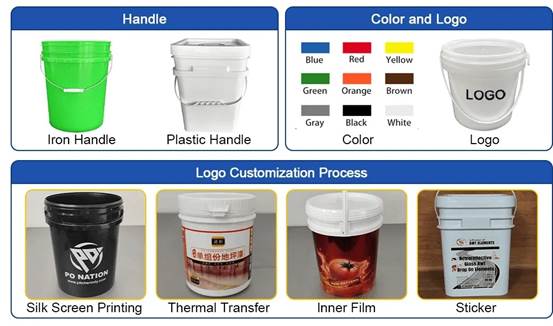
For OEM and wholesale projects, I look beyond unit price.I check raw material control, production equipment, mold condition, lid matching, dimensional consistency, inspection records, and batch traceability.
This matters because distributors and industrial users often reorder the same packaging for years. They expect the next order to work with the same filling equipment, labels, pallets, and transport system.A slightly lower price does not create much value if the bucket dimensions, wall thickness, or lid fit change between batches.
FAQ
Q: What Plastic Is Best For Chemical Storage?
A: I often use HDPE for chemical packaging and PP when higher rigidity or heat resistance is useful. I still check the exact chemical, concentration, temperature, and storage conditions first.
Q: Are HDPE Buckets Safe For Chemicals?
A: HDPE works with many industrial chemicals, but I do not treat it as suitable for every formulation. I confirm chemical compatibility before recommending it.
Q: When Do I Need A UN-Rated Plastic Bucket?
A: I check for UN-rated packaging when the contents are classified as dangerous goods and applicable transport rules require approved performance packaging.
Q: What Lid Is Best For Liquid Chemicals?
A: I usually choose a secure closure with a compatible gasket when leakage control is important. I match the lid to the liquid, viscosity, filling process, and transport conditions.
Q: What Information Should I Provide When Requesting A Quotation?
A: I recommend providing the product name, concentration, filling temperature, capacity, filled weight, lid type, certification needs, storage conditions, customization requirements, and order quantity.
Conclusion
I choose chemical plastic buckets by checking the contents first, then material, sealing, strength, certification, logistics, and production consistency before comparing price.
My Role
I have worked with plastic pallets and industrial plastic packaging for many years. I focus on how products are filled, stored, stacked, transported, and handled in real working conditions.
About Enlightening Plast
We are Enlightening Plast, a China-based plastic packaging manufacturer with more than 20 years of manufacturing experience.We work with brand owners, wholesalers, distributors, and industrial buyers. We support standard products, custom colors, logos, molds, and OEM packaging projects.
Our production system includes more than 60 injection molding and rotational molding machines. We check raw materials, dimensions, assembly, and finished products to help maintain stable quality across bulk orders.We serve customers in global markets and focus on stable production, practical customization, quality control, and long-term supply.


