


Buying the wrong bucket size can cause filling errors, product spills, and higher shipping costs. You need to understand its actual capacity before placing a bulk order.
A standard 5-US-gallon bucket holds 18.93 liters or 18,927 milliliters. It also equals 20 quarts, 40 pints, 80 cups, and 1,155 cubic inches. Its brimful capacity can be higher, depending on the bucket design.
I have worked in plastic bucket manufacturing for more than 20 years at Enlightening Plast. I often see buyers focus on the 5-gallon label but overlook the bucket's actual dimensions, wall thickness, and filling level. These details affect packaging, storage, and transportation. In this guide, I will explain how I evaluate bucket capacity and help you choose the right plastic bucket for your business.
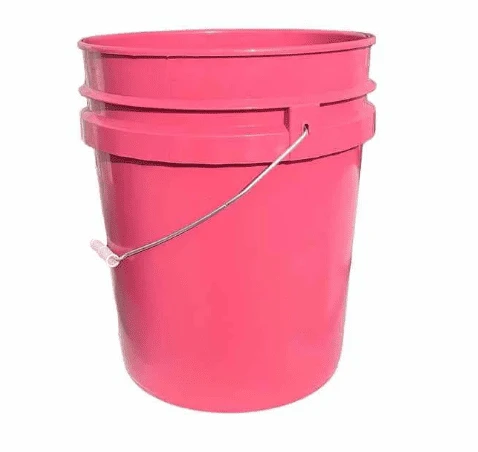
How Much Does a 5-Gallon Bucket Hold?

A bucket marked 5 gallons does not always have an internal volume of exactly 5 gallons. I always explain the difference between its nominal capacity and brimful capacity before discussing packaging requirements with buyers.
A standard 5-gallon bucket has a nominal capacity of 18.93 liters. Its brimful capacity may reach approximately 5.3–5.5 gallons in some commercial models. The exact volume depends on the mold and internal dimensions.
When we design plastic buckets, we consider two different measurements:
Nominal Capacity: The stated working capacity, which is 5 US gallons for a standard 5-gallon bucket.
Brimful Capacity: The maximum physical volume when the bucket is filled to its rim.
|
Capacity Type |
US Gallons |
Liters |
|
Nominal Capacity |
5.00 |
18.93 |
|
Example Brimful Capacity |
5.30–5.50 |
20.06–20.82 |
I do not recommend filling a bucket to its rim. The empty space above the liquid allows room for lid installation and reduces the risk of spills during transportation. Some liquids also expand when temperatures change. The correct filling level depends on the product and packaging requirements.
5-Gallon Bucket Volume in Different Units
I work with buyers from North America, Europe, and other markets. They do not always use the same volume units. I recommend confirming the measurement system before approving packaging specifications.
Five US gallons equal 18.927 liters, 18,927 milliliters, 20 US quarts, 40 US pints, 80 US cups, and 640 US fluid ounces.
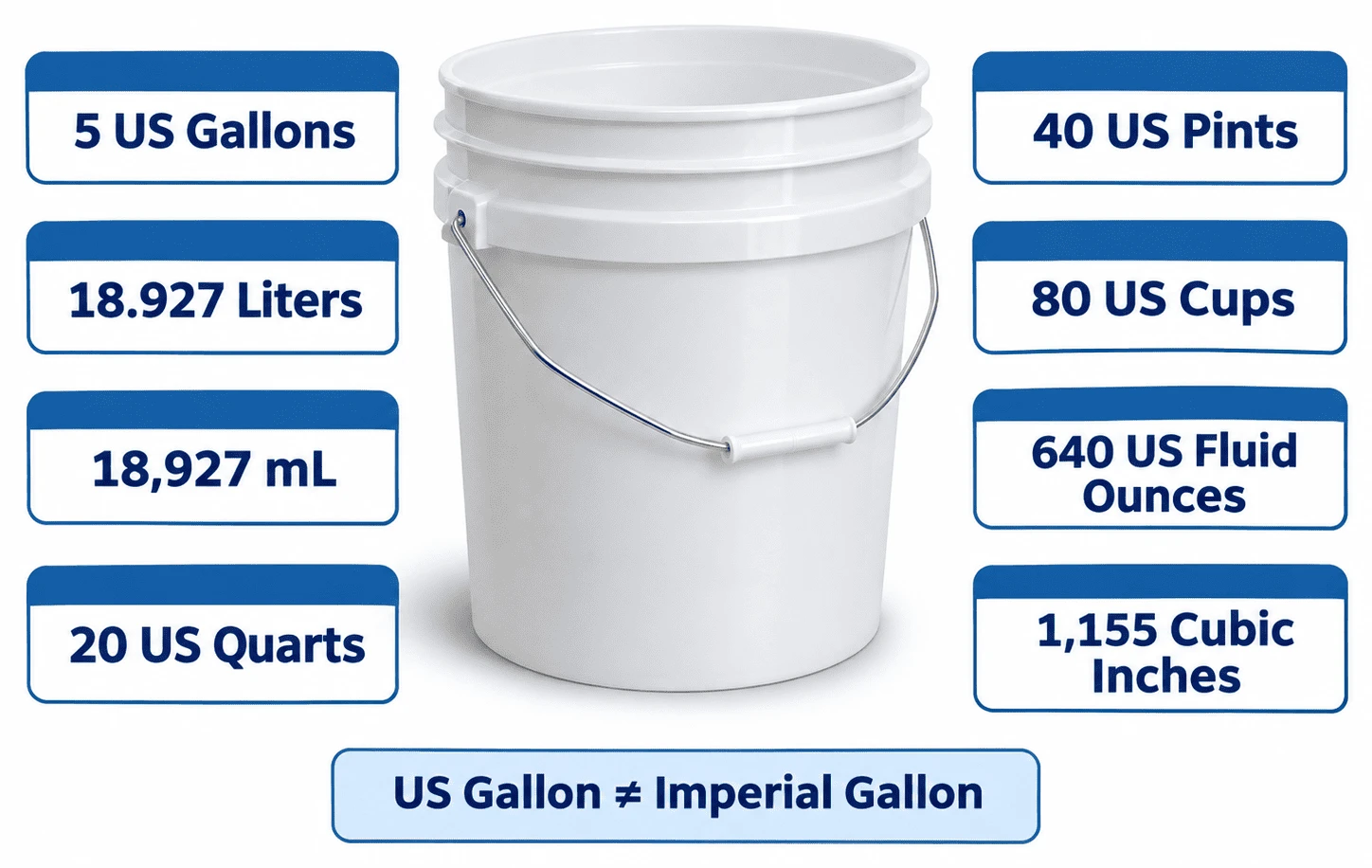
|
Measurement Unit |
Equivalent to 5 US Gallons |
|
Liters |
18.927 L |
|
Milliliters |
18,927 mL |
|
US Quarts |
20 qt |
|
US Pints |
40 pt |
|
US Cups |
80 cups |
|
US Fluid Ounces |
640 fl oz |
|
Cubic Inches |
1,155 in³ |
|
Cubic Feet |
0.6684 ft³ |
I also remind international buyers that US gallons and Imperial gallons are different. One US gallon equals approximately 3.785 liters, while one Imperial gallon equals 4.546 liters. Therefore, 5 US gallons equal about 4.16 Imperial gallons. Checking this difference helps prevent errors in filling quantities and product specifications.
What Are the Dimensions of a 5-Gallon Bucket?
When buyers order plastic buckets, I check more than capacity. Height, top diameter, bottom diameter, and wall thickness all affect whether the bucket fits their filling equipment and storage system.
A common round 5-gallon bucket is approximately 14.5 inches tall, with a top diameter of around 11.9 inches and a bottom diameter of around 10.3 inches. These are reference measurements, not universal standards.

Why Does a 5-Gallon Bucket Have a Tapered Shape?
Most round plastic buckets have a wider opening and a narrower bottom. We use this tapered structure to make empty buckets easier to nest inside one another.
This design reduces storage and shipping space for wholesale orders. It also supports the release of the molded bucket from the injection mold. I consider the taper when designing the bucket because it affects both internal capacity and production.
Common 5-Gallon Bucket Dimensions
|
Dimension |
Common Reference |
|
Height |
14.2–14.7 inches |
|
Top Outside Diameter |
11.7–11.9 inches |
|
Bottom Outside Diameter |
10.1–10.3 inches |
|
Typical Empty Weight |
0.9–1.1 kg |
These dimensions vary between round and square buckets. For example, our 5-gallon square plastic bucket has a height of 363 mm, a top dimension of 297 mm, a wall thickness of 1.8 mm, and a body-plus-lid weight of 920 g.
I also distinguish internal dimensions from external dimensions. The bucket wall takes up space, so outside measurements cannot give an exact internal volume. When buyers need a specific capacity, I check the mold dimensions and confirm the finished product through measurement.
How to Calculate the Volume of a 5-Gallon Bucket?
I use volume formulas when developing new bucket sizes or checking custom designs. A cylindrical container and a tapered bucket need different formulas because their internal shapes are different.
A cylindrical bucket uses V = πr²h. A tapered bucket uses the frustum formula: V = πh(R² + Rr + r²) ÷ 3.
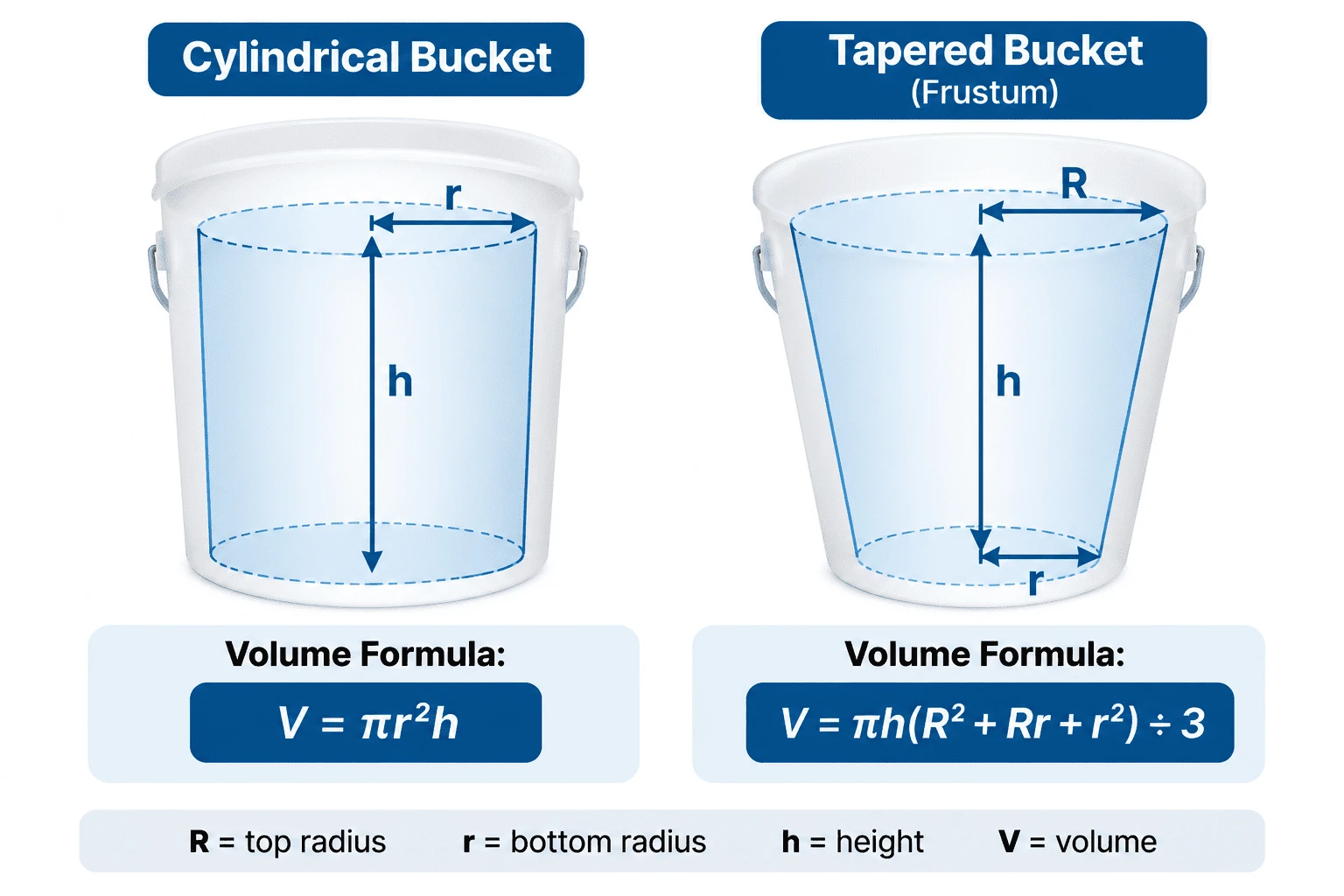
Volume Formula for a Cylindrical Bucket
For a straight cylindrical container, I use:
V = π × r² × h
Where r is the internal radius and h is the internal height.
For example, a container with an internal radius of 5 inches and an internal height of 14 inches has a volume of approximately 1,099.6 cubic inches.
I divide this result by 231 to convert it into US gallons:
1,099.6 ÷ 231 = 4.76 gallons.
Volume Formula for a Tapered Bucket
For a tapered bucket, I use:
V = (π × h ÷ 3) × (R² + Rr + r²)
Where:
R = Internal top radius
r = Internal bottom radius
h = Internal height
For example, if the top radius is 5.5 inches, the bottom radius is 4.5 inches, and the internal height is 13 inches, the calculated volume is approximately 1,024.42 cubic inches, or 4.43 US gallons.
How to Calculate Bucket Volume Step by Step
I follow these steps when checking a bucket's approximate capacity:
Measure the internal top diameter.
Measure the internal bottom diameter.
Measure the internal height.
Divide both diameters by two to get the radii.
Apply the tapered bucket formula.
Divide cubic inches by 231 to get US gallons.
For custom production, I also recommend a physical water-filling test. The formula gives an estimate, while the finished product confirms the actual capacity.
How Much Does a 5-Gallon Bucket Weigh When Full?
The filled weight depends on the material inside. Five gallons of water weigh approximately 41.7 pounds or 18.9 kg. With an empty bucket weighing around 0.9–1.1 kg, the total weight is about 19.8–20 kg.
Weight of Common Liquids in a 5-Gallon Bucket
I use specific gravity to estimate the weight of different liquids.
Liquid Weight (lb) = 5 × Specific Gravity × 8.34
|
Liquid |
Example Specific Gravity |
Approximate Weight |
|
Water |
1.00 |
41.7 lb |
|
Cooking Oil |
0.92 |
38.4 lb |
|
Detergent |
1.05 |
43.8 lb |
|
Heavy Liquid |
1.20 |
50.0 lb |
These are calculation examples. Actual liquid density depends on its formulation and temperature.
Weight of Dry Materials in a 5-Gallon Bucket
Dry materials use bulk density to calculate weight. Five gallons of flour, sugar, sand, or plastic pellets can have very different weights. Particle size and packing conditions also affect the result.
I recommend weighing a sample when the exact filled weight matters. This helps buyers select a suitable bucket and handle.
How Does Bucket Design Affect Load Handling?
I check the wall thickness, bottom structure, handle connection, and lid when evaluating a bucket for heavy materials. A metal handle can suit heavier loads, while a plastic handle may work for lighter applications.
A 5-gallon bucket does not have one universal load limit. I recommend testing the complete bucket under its expected filling, lifting, and transportation conditions before placing a large order.
What Can You Put in a 5-Gallon Bucket?
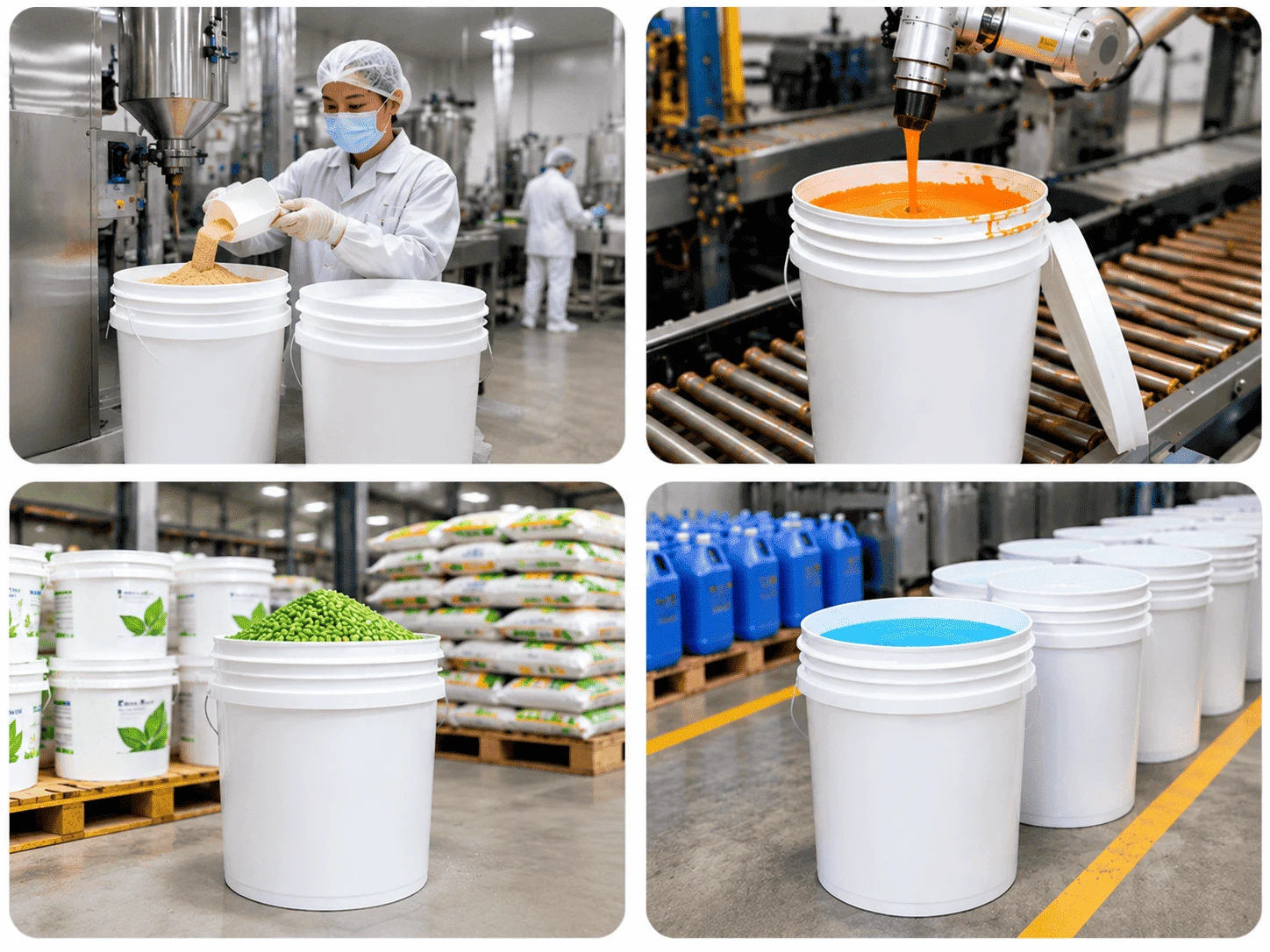
I have supplied plastic buckets for food processing, paint, agriculture, cleaning products, and industrial packaging. Each application needs a suitable material and lid configuration.
A 5-gallon bucket can hold water, food ingredients, paint, coatings, cleaning liquids, and selected industrial materials. The correct choice depends on chemical compatibility, temperature, and packaging requirements.
HDPE buckets are commonly used for water, cleaning liquids, and many industrial liquids. I check the liquid's properties and the sealing performance of the lid before recommending a model.
Flour, sugar, grains, honey, and other food ingredients need suitable food-contact packaging. I check the resin, additives, colorants, and manufacturing process rather than relying only on the HDPE or PP label. You can read our guide on how to identify food-grade plastic buckets before choosing packaging for food products.
Paint manufacturers need buckets with suitable wall strength and secure lids. I often recommend tear-tab lids when buyers need visible evidence that the package has not been opened. Our 5-gallon round plastic buckets for paint and coatings offer HDPE or PP material options and metal handle configurations.
Industrial buyers may use plastic buckets for detergents, fertilizers, lubricants, and chemical ingredients. I always check chemical compatibility before selecting the resin. For regulated hazardous materials, the packaging must also meet the applicable transport requirements.
How to Choose the Right 5-Gallon Plastic Bucket?
When I help buyers choose a plastic bucket, I start with the contents and working conditions. I then check the material, lid, handle, dimensions, and order requirements.

HDPE vs. PP Plastic Buckets
HDPE and PP are two common materials used in bucket manufacturing.
|
Comparison |
HDPE |
PP |
|
Impact Resistance |
Generally good |
Depends on grade |
|
Rigidity |
More flexible |
More rigid |
|
Low-Temperature Performance |
Generally better |
Requires careful selection |
|
Heat Resistance |
Generally lower |
Generally higher |
|
Common Uses |
Industrial and liquid packaging |
Food and selected hot-fill applications |
I often recommend HDPE for applications that need good impact resistance. PP can be a better choice when higher heat resistance or rigidity is required. You can read our HDPE vs. PP plastic bucket material guide for more details.
Food-Grade vs. Industrial Buckets
Food-grade buckets need suitable raw materials and controlled production processes. Industrial buckets may use different resin grades according to their contents and intended use.
For food packaging, I check the relevant food-contact requirements and provide supporting documents according to the product and target market.
Bucket Lids and Sealing Options
I recommend different lids for different packaging needs:
Standard Snap-On Lid: Suitable for general storage.
Gasket Lid: Adds a sealing component for suitable liquid applications.
Tear-Tab Lid: Provides tamper evidence.
Pour Spout Lid: Makes liquid dispensing easier.
The lid must match the bucket model. I also check the gasket material when the contents require chemical resistance.
Plastic vs. Metal Handles
Plastic handles suit many lighter packaging applications. Metal wire handles with plastic grips are common for heavier buckets used for paint and industrial products. I select the handle according to the filled weight and expected handling conditions.
Standard vs. Custom 5-Gallon Buckets
Standard buckets suit buyers who need established sizes and configurations. Custom buckets allow changes to color, logo, lid, and other product details.
At Enlightening Plast, we use injection molding technology and operate more than 60 injection molding machines. We support HDPE and PP material options, OEM/ODM customization, and bulk orders. Our quality process includes raw material checks, dimensional inspection, and finished-product inspection.
For food and beverage packaging, our plastic bucket solutions for the food and beverage industry cover different container materials and packaging requirements.
Before production, I recommend confirming the capacity, dimensions, material, lid type, handle, and destination market. These details help us prepare a suitable quotation and maintain consistent specifications for repeat orders.
Frequently Asked Questions About 5-Gallon Bucket Volume
Q: Is A 5-Gallon Bucket Exactly 5 Gallons?
A: A 5-gallon bucket has a nominal capacity of 5 US gallons, or 18.93 liters. Its brimful capacity can be higher depending on its design.
Q: How Many Liters Are In A 5-Gallon Bucket?
A: Five US gallons equal approximately 18.93 liters or 18,927 milliliters.
Q: How Many Cups Are In A 5-Gallon Bucket?
A: Five US gallons equal 80 US cups because one US gallon contains 16 US cups.
Q: How Many Cubic Inches Are In A 5-Gallon Bucket?
A: Five US gallons equal exactly 1,155 cubic inches.
Q: How Much Does An Empty 5-Gallon Bucket Weigh?
A: A typical empty 5-gallon plastic bucket weighs around 0.9–1.1 kg, depending on its material, wall thickness, handle, and lid.
Q: Can A 5-Gallon Bucket Hold More Than 5 Gallons?
A: Yes. Some models have a brimful capacity of approximately 5.3–5.5 gallons. However, buyers should follow the recommended filling level rather than filling to the rim.
Q: What Are The Standard Dimensions Of A 5-Gallon Bucket?
A: A common round model is around 14.5 inches tall, with a top diameter of 11.9 inches and a bottom diameter of 10.3 inches. Actual dimensions vary by manufacturer.
Q: How Much Weight Can A 5-Gallon Plastic Bucket Hold?
A: There is no universal load limit. The safe load depends on wall thickness, material, bottom structure, handle design, and working conditions.
Conclusion
A 5-gallon bucket holds 18.93 liters, but its actual capacity and load performance depend on its design. I recommend checking these details before choosing a plastic bucket for your business.


